AI Astrology vs. Human Astrologers: Which Is Right for You?
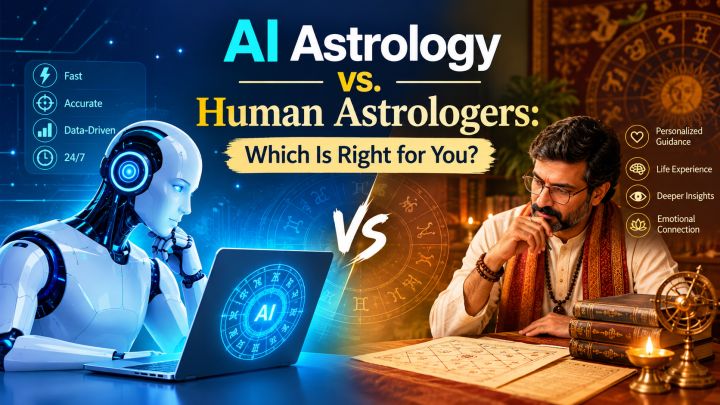
Quick summary:
- AI astrology tools and human astrologers do different jobs. A good AI tool calculates your birth chart with the same astronomical precision a professional astrologer’s software uses, but it is weaker at interpretation.
- A human astrologer is the reverse: strong on nuance, but slower and costlier for quick, repeated questions. The right choice depends on what you are actually asking.
- If you have asked an AI astrology app a question and also paid for a session with a real astrologer, the answers probably did not feel the same. That is not a coincidence.
- In the AI vs human astrologer debate, the two tools are built for different jobs. One leans on math, the other on judgment. Confusing the two is where most of the disagreement about which is “better” comes from.
AI Astrology vs. Real Astrology: Calculation vs. Interpretation
The real difference is not robot versus person. It is calculation versus judgment.
A birth chart starts with astronomical positions calculated for a specific birth time and place. A human astrologer typically pulls that data from established chart software, then spends years learning to weave the placements into a reading that fits your life.
An AI tool tries to do both steps at once. It gets the math right, then generates the interpretation, often in seconds. That second step is where AI astrology vs. real astrology comparisons usually break down.
AI Birth Chart Accuracy: How to Spot Real Math vs. a Guess
AI birth chart accuracy comes down to one question: is the tool actually calculating your chart, or guessing at what one might look like?
Some apps run your birth data through a real astronomical engine, most commonly the Swiss Ephemeris, built on NASA JPL planetary data and accurate to a fraction of an arcsecond. Others hand your birth date to a general-purpose chatbot and ask it to describe a chart.
A chatbot asked to produce planetary positions from scratch is predicting plausible-looking text, not running an astronomical calculation. The result can look coherent while not matching where the sky actually was.
You can tell the two apart in about two minutes:
- Enter an exact birth time, date, and city. A calculation-based tool asks for all three. One that works fine off just a birth date is your first clue it is not doing real chart math.
- Change the birth time by two or three hours and run it again. Your Sun sign should barely move, but your Ascendant and house placements should shift noticeably. The Ascendant moves roughly one degree every four minutes, because Earth rotates 360 degrees in 24 hours. If nothing changes, the tool is likely not computing houses at all.
- Cross-check one placement against a known chart calculator. Free tools built on the Swiss Ephemeris are widely available. If your AI tool’s planet positions are off, the problem is the math, not the interpretation style.
That test tells you whether you are questioning the astronomy or the astrology. Those are two different kinds of “wrong,” worth telling apart before you trust either.
AI vs. Vedic Astrology: Why the Ayanamsa Can Change Your Sign
AI vs Vedic astrology comparisons hide an extra variable that Western-only comparisons skip: which zodiac the tool is even using.
Western astrology uses the tropical zodiac, anchored to the seasons. Zero degrees Aries is always the spring equinox. Vedic, or Jyotish, astrology uses the sidereal zodiac, anchored to the actual background stars.
The two drift apart over time as Earth’s axis slowly precesses. The gap between them is called the ayanamsa.
Lahiri is one of the most widely used ayanamsas in Vedic astrology, adopted as India’s national standard following the Calendar Reform Committee’s work in the 1950s.
As of 2026 that gap is roughly 24 degrees and grows by about 50 arcseconds a year. That is small year to year, but it is why a Vedic AI tool can hand you a different sign than a Western one, using identical birth data.
If an AI astrology tool does not say which ayanamsa it uses, or does not let Vedic users choose one, that is a real gap in the product, not a small detail, since it can change your sign.
This is also worth checking before trusting any single AI astrologer review. A glowing review of a Western AI tool tells you nothing about how that company’s Vedic mode handles the ayanamsa question.
What a Human Astrologer Still Does Better
Interpretation is where a person has the edge. A trained astrologer can notice that two clients with an identical placement are living it out in completely different ways, one through a career shift, one through a relationship, and adjust the reading accordingly.
AI tools tend to flatten that nuance into general trends. They are pattern-matching across huge volumes of text rather than sitting with your specific situation. Astrologers also pick up on what you are not saying and ask a sharper follow-up question, which no current AI astrology tool does well.
What AI Astrology Does Better (and Where It Falls Short)
Speed, availability, and consistency are AI’s real strengths.
You can ask a question at 2 a.m. and get an answer built from the same calculation every time, with no scheduling and usually no per-question fee. If you check transits often, or want to compare a few “what if” birth times, AI removes friction a human session cannot.
AI Astrology Limitations: What the Tool Can’t See
The biggest AI astrology limitations are not about speed. They are about what the tool cannot see.
- Calculation quality varies between apps, and most do not disclose which engine or ayanamsa they run on.
- Interpretation comes from patterns in text, not lived understanding of your circumstances.
- Emotional nuance and follow-up judgment remain weak points.
- Some products blur AI-generated output with the impression of a real practitioner behind the reading.
Should I use AI astrology? A quick way to decide
If you want frequent, low-stakes check-ins on transits or timing, an AI tool built on a real ephemeris is a reasonable fit.
If you are weighing something with real emotional weight, a career change, a relationship decision, a loss, a human astrologer can offer conversation, follow-up questions, and context that an automated reading cannot.
Plenty of people use both: AI for the daily glance, a person for the moments that need a conversation. Whichever side of the AI vs human astrologer question you land on for a given question, the same rule holds. Use AI for volume, use a person for weight.
Astrology itself, AI-assisted or not, is a tradition for reflection, not a verified predictive system. It is not a substitute for medical, legal, or financial advice.
FAQ: AI Astrology vs. Human Astrologers
Is AI astrology as accurate as a human astrologer?
The astronomical calculation can be just as accurate as what a professional astrologer’s software produces, provided the AI tool uses a real ephemeris. The interpretation is a separate question, and human judgment still tends to hold up better there.
Can I trust an AI birth chart without checking anything?
Run the three-step test above the first time you try a new tool, especially if the app does not disclose what calculation engine it uses.
Curious what your own placements mean once the chart is right? Run your birth details through a calculator that shows its ayanamsa and house system before you read the interpretation.
If a real decision is riding on your chart, book a session with a human astrologer to talk it through, rather than relying on a single AI reading alone.
Tags: AI astrologer review, AI astrology limitations, AI astrology vs real astrology, AI birth chart accuracy, AI vs human astrologer, AI vs Vedic astrology, should I use AI astrology
No Comments