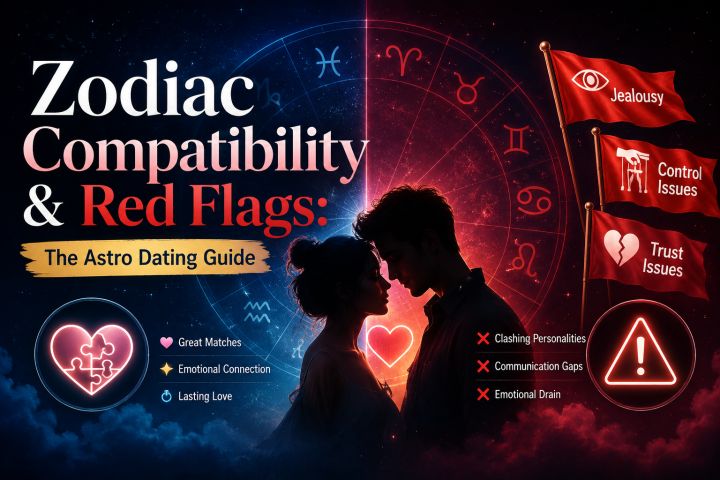
Zodiac Compatibility & Red Flags: The Astro Dating Guide
Quick Summary
- How zodiac compatibility works beyond basic Sun-sign matching
- A zodiac compatibility chart based on elements, modalities, and planetary rulerships
- Common zodiac red flags associated with each sign
- How astrology dating apps use compatibility to match people
Astro dating has moved beyond casual horoscope talk. For some people, a zodiac sign is now part of how they start conversations, assess chemistry, or decide who to swipe on.
Dating by zodiac sign can be a fun way to explore personality and relationship dynamics. This guide explains how zodiac compatibility works, which pairings astrologers often consider compatible, and what zodiac red flags may show up in relationships.
What Is Zodiac Compatibility?
Zodiac compatibility is the astrological practice of comparing two people’s signs to explore how their personalities and relationship styles may interact. Sun signs are the simplest starting point, while a fuller birth chart can include the Moon, Venus, Mars, and Rising signs.
Astrology isn’t a scientifically proven way to predict whether a relationship will succeed. Within astrology, compatibility is better viewed as a framework for reflection and conversation rather than a fixed prediction.
Three ideas commonly shape a compatibility reading: element, modality, and planetary rulership.
Elements describe broad temperament. Modalities describe how a sign approaches action and change. Planetary rulership adds another layer by connecting each sign with particular motivations and themes.
For example, Taurus and Cancer are often considered a good match because earth and water are traditionally viewed as complementary. Taurus tends to value stability, while Cancer is associated with emotional responsiveness and security. Together, those qualities can create a strong sense of familiarity and comfort.
How Astro Dating Works: Elements and Modalities
The four elements in Western astrology have roots in ancient Greek philosophy. Empedocles associated fire, earth, air, and water with the basic composition of the natural world. Hellenistic astrology later organized zodiac signs into elemental groups called triplicities.
Today, elements remain one of the simplest ways to discuss compatibility.
The four elements:
- Fire: Aries, Leo, Sagittarius — energetic, expressive, action-oriented
- Earth: Taurus, Virgo, Capricorn — practical, grounded, consistent
- Air: Gemini, Libra, Aquarius — social, curious, communicative
- Water: Cancer, Scorpio, Pisces — intuitive, emotional, sensitive
The three modalities:
- Cardinal: Aries, Cancer, Libra, Capricorn — initiators
- Fixed: Taurus, Leo, Scorpio, Aquarius — persistent and steady
- Mutable: Gemini, Virgo, Sagittarius, Pisces — flexible and adaptable
Astrologers may also consider planetary rulership. Traditional and modern astrology differ for some signs. For example, Scorpio is traditionally ruled by Mars and is associated with Pluto in modern astrology.
Zodiac Compatibility Chart
Use this zodiac compatibility chart as a reference, not a rulebook. These pairings reflect common Western astrology interpretations based on elements, modalities, polarity, and planetary rulership. Different astrologers may interpret the same pairing differently.
| Sign | Element | Modality | Ruling Planet | Traditionally Easy Matches | Growth-Oriented Matches |
| Aries | Fire | Cardinal | Mars | Leo, Sagittarius | Libra, Cancer |
| Taurus | Earth | Fixed | Venus | Virgo, Capricorn, Cancer | Scorpio, Leo |
| Gemini | Air | Mutable | Mercury | Libra, Aquarius | Sagittarius, Virgo |
| Cancer | Water | Cardinal | Moon | Scorpio, Pisces, Taurus | Capricorn, Aries |
| Leo | Fire | Fixed | Sun | Aries, Sagittarius | Aquarius, Taurus |
| Virgo | Earth | Mutable | Mercury | Taurus, Capricorn | Pisces, Gemini |
| Libra | Air | Cardinal | Venus | Gemini, Aquarius | Aries, Capricorn |
| Scorpio | Water | Fixed | Mars/Pluto | Cancer, Pisces | Taurus, Leo |
| Sagittarius | Fire | Mutable | Jupiter | Aries, Leo | Gemini, Virgo |
| Capricorn | Earth | Cardinal | Saturn | Taurus, Virgo, Scorpio | Cancer, Libra |
| Aquarius | Air | Fixed | Saturn/Uranus | Gemini, Libra | Leo, Scorpio |
| Pisces | Water | Mutable | Jupiter/Neptune | Cancer, Scorpio | Virgo, Sagittarius |
*Traditional and modern rulerships are both shown where they differ.
A growth match isn’t necessarily a bad zodiac match. These pairings may involve more differences in temperament and require greater understanding of communication styles, priorities, and expectations.
Which Zodiac Signs Are Compatible?
If you’re wondering which zodiac signs are compatible, traditional astrology often points to signs with complementary elements or similar relationship rhythms.
Some of the best zodiac couples commonly highlighted include:
- Taurus and Cancer: A grounded pairing that may value security, loyalty, and home life.
- Gemini and Libra: Two air signs often associated with communication, curiosity, and social connection.
- Leo and Sagittarius: A lively fire-sign pairing that may share enthusiasm and a love of adventure.
- Scorpio and Cancer: Two water signs traditionally associated with emotional depth and strong attachment.
- Virgo and Capricorn: An earth-sign pairing that may appreciate reliability, planning, and practical commitment.
A strong zodiac match on paper doesn’t guarantee chemistry. Shared qualities can bring people closer, but they can also amplify the same weaknesses.
Your Sun sign is only one part of a birth chart. Astrologers may also look at the Moon for emotional tendencies, Venus for affection and attraction, Mars for desire and conflict, and the Rising sign for outward style and first impressions.
Zodiac Red Flags by Sign
Zodiac red flags are best understood as potential shadow traits rather than fixed personality flaws. They may become more noticeable during stress or conflict.
| Sign | Traditional Strength | Red Flag Under Stress |
| Aries | Directness, initiative | Impatience, picking fights to feel in control |
| Taurus | Loyalty, consistency | Stubbornness, resistance to any compromise |
| Gemini | Curiosity, adaptability | Inconsistency, avoiding hard conversations |
| Cancer | Nurturing, emotional depth | Guilt-driven withdrawal, reading moods instead of stating needs |
| Leo | Warmth, generosity | Needing constant validation, making conflict about ego |
| Virgo | Attention to detail, reliability | Chronic criticism, treating a partner like a project |
| Libra | Fairness, diplomacy | Conflict avoidance, indecision that stalls the relationship |
| Scorpio | Intensity, loyalty | Jealousy, testing a partner’s commitment |
| Sagittarius | Optimism, independence | Commitment avoidance, restlessness when things get serious |
| Capricorn | Ambition, dependability | Emotional distance, prioritizing work over connection |
| Aquarius | Originality, independence | Detachment, difficulty naming feelings directly |
| Pisces | Empathy, imagination | Escapism, idealizing a partner instead of seeing them clearly |
The point isn’t to label someone based on their Sun sign. If a potential red flag appears, look at the person’s actual behavior and how they respond when the issue is discussed.
Astrology Dating Apps: How They Use Compatibility
An astrology dating app may use birth-chart information to add an astrological layer to matchmaking. Some apps compare multiple placements instead of relying only on Sun signs, while others focus on compatibility reports or relationship insights.
That can offer more context than a simple zodiac percentage. However, a zodiac match score is still an interpretation of astrological information, not a scientific measurement of relationship potential.
The same applies to zodiac sign compatibility love predictions. A favorable score doesn’t guarantee a healthy relationship, and a challenging score doesn’t mean two people won’t work.
The best approach is to treat these tools as a starting point. If an app says two people are a strong match, see whether their values, communication styles, and expectations actually line up.
How to Use Zodiac Compatibility Without Overreading It
Zodiac compatibility works best as a conversation starter, not a dating filter.
A challenging pairing doesn’t automatically mean a relationship will fail. An easy pairing doesn’t guarantee that two people will be happy together either.
Instead of asking only whether someone is your ideal zodiac match, use astrology to open up better conversations:
- How do you handle conflict?
- What makes you feel secure in a relationship?
- How do you communicate when you’re upset?
- What does commitment mean to you?
- Which differences feel exciting, and which create real problems?
Astrology can provide a framework for reflection, but real compatibility comes down to how two people communicate, respect each other, and handle differences.
Frequently Asked Questions
Can two people with the same zodiac sign make a good match?
Yes. Same-sign pairings can share similar strengths and challenges. Two Geminis, for example, may enjoy easy conversation while also needing to make room for deeper discussions.
Which zodiac signs are most compatible?
Traditional astrology often highlights pairings with complementary elements, such as Taurus and Cancer, Gemini and Libra, Leo and Sagittarius, and Scorpio and Cancer. A full birth-chart comparison can produce a different result.
Can incompatible zodiac signs have successful relationships?
Yes. A challenging astrological pairing doesn’t determine relationship success. Communication, trust, shared values, boundaries, and emotional maturity have a much greater impact on a relationship.
Does zodiac compatibility depend only on Sun signs?
No. Sun signs are only one part of an astrological compatibility reading. Astrologers may also compare Moon, Venus, Mars, Rising signs, and other placements for additional context.
Are zodiac compatibility scores scientifically proven?
No. Astrology isn’t scientifically validated as a method for predicting relationship compatibility. Compatibility scores are better treated as entertainment or personal reflection than as objective relationship assessments.
Whether you’re curious about dating by zodiac sign or simply comparing charts for fun, astrology can give you something to talk about. Just remember that the person behind the birth chart matters more than the sign on the page.
No Comments