Tarot for Beginners: How to Read Tarot Cards Step by Step
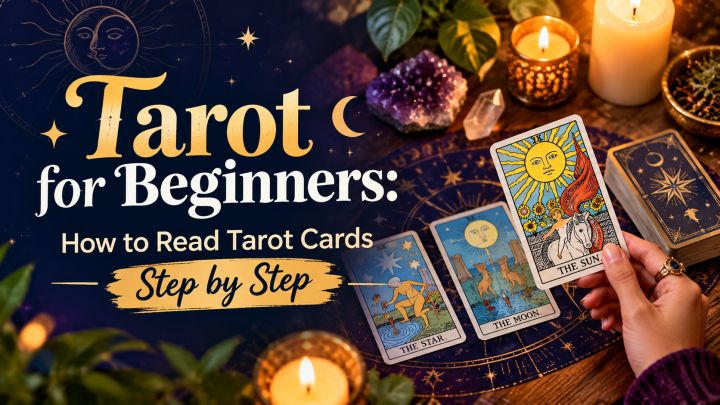
Quick summary:
- Pick an open-ended question and shuffle while holding it in mind.
- Draw one to three cards, and read the image before checking any meaning.
- Journal what you notice — patterns tend to show up after a few readings.
- Rider-Waite-Smith decks are the easiest starting point for beginners.
You just bought a deck, you’re staring at 78 cards, and you don’t know how to read tarot cards. That’s a normal place to start with tarot for beginners, and it’s fixable in about ten minutes. This guide walks you through what it takes to learn tarot, starting with your very first pull.
What Is Tarot? A Beginner’s Guide
Tarot is a 78-card deck that started out as a European trade item, not a mystical tool. It most likely reached Europe through Venice’s ports in the 15th century, carried along Mediterranean trade routes by merchants, traders, and seafarers. The oldest surviving decks were hand-painted for Italian noble families to play a card game, not to predict anything (Victoria and Albert Museum).
Divination came much later. In the late 18th century, French occultists made elaborate, unsubstantiated claims about tarot’s history and meaning, and that’s what led to decks built specifically for divination and card reading (Wikipedia).
The deck most beginners picture, the one with a full illustrated scene on every card, came later still. In 1909, occultist Arthur Edward Waite commissioned artist Pamela Colman Smith to design a 78-card deck, now known as the Rider-Waite-Smith deck (Victoria and Albert Museum).
None of that history makes tarot predictive. It’s better understood as a structured way to reflect: the images give your mind something concrete to react to, and your own thinking does the rest. Seen that way, a first reading stops feeling like something you can fail.
What You Need for Your First Tarot Reading
You need three things: a deck, ten quiet minutes, and, optionally, a notebook. Here’s what tarot for beginners should know about each.
- A deck. Rider-Waite-Smith-based decks are the easiest entry point for choosing your first tarot deck [internal link: needs URL], since most beginner resources, this one included, use that imagery and numbering.
- Ten quiet minutes. No candles or special cloth required, just somewhere you won’t be interrupted.
- A notebook. Optional, but it’s the fastest way to improve. Jot down your question, the cards you drew, and what you thought at the time, and a one-off reading turns into something you can build on.
That’s tarot reading basics covered before you even draw a card.
How to Do a Tarot Reading: 6 Simple Steps
Follow these six steps for any first tarot reading, whether you’re pulling one card or laying out a full spread.
- Pick an open-ended question. Skip yes/no phrasing. “What do I need to know about this job situation?” gives the cards more to work with than “Will I get the job?”
- Shuffle while holding the question in mind. Overhand, riffle, or just mixing the cards on a table — any method works.
- Cut the deck and draw. For your first reading, pull one to three cards. More cards means more to interpret, and that can leave you lost before you’ve learned the basics.
- Look at the image before you check any meaning. Notice the colors, the expressions, what’s in the foreground versus the background. Your first reaction is worth writing down.
- Check the card’s traditional meaning and compare it to your reaction. Where the two line up is usually the strongest signal.
- Journal it. Date, question, cards drawn, what you took from it. Six months from now, that log becomes a reference you’ll actually use.
That’s tarot reading basics in full: a question, a shuffle, a draw, and a few honest notes.
How to Do a Three-Card Tarot Reading
Once a single card feels manageable, the three-card spread [internal link: needs URL] is the standard next step for tarot for beginners ready to go further. It’s a good fit for your first tarot reading because it stays simple enough to read without getting overwhelming. Lay three cards left to right:
- Card 1, Past: what’s already shaping the situation
- Card 2, Present: where things stand right now
- Card 3, Likely direction: where things may be headed if nothing changes
Read the three cards together, not as three separate definitions. The relationship between them is what turns a spread into a reading.
Tarot Card Meanings for Beginners: 6 Cards to Know
You don’t need all 78 cards memorized for a first reading, just somewhere to start. Here are six cards beginners draw often, read as tradition and reflection, not fixed fact.
| Card | Traditional meaning (upright) |
| The Fool | New beginnings, taking a leap, a fresh start |
| The Empress | Nurturing, abundance, creativity |
| The Emperor | Structure, authority, stability |
| The Lovers | A choice, a meaningful connection |
| The Wheel of Fortune | Change, cycles, timing outside your control |
| The Star | Hope, renewal after a hard stretch |
These tarot card meanings for beginners cover cards you’ll likely see early on. If you draw something not on this list, the small booklet most decks ship with will cover it. Use that until the meanings start to stick on their own.
Common Tarot Mistakes Beginners Make
These are the mistakes tarot for beginners run into most often.
- Pulling too many cards. A ten-card spread on day one can leave you lost. Start with one to three.
- Treating a reading as a fixed prediction. A card may point at a pattern or a tension in your life, not a guaranteed outcome.
- Skipping your own first impression. It’s tempting to flip straight to the guidebook, but that gut reaction before you read anything is part of the value.
- Quitting after one confusing card. Every tarot reader has pulled a card that meant nothing to them at first. That’s normal, not a sign you’re doing it wrong.
Frequently Asked Questions
How many cards should a beginner draw? One to three. A single card works for a daily practice pull; three cards (past, present, likely direction) is the natural next step.
Is there a fast way to learn how to read tarot cards? Practice with one card a day and a journal. Repetition, not memorization, is what makes the meanings stick.
Do I need a specific deck to learn tarot? No. Any 78-card deck works, though Rider-Waite-Smith-based decks are easiest to start with, since most learning resources reference that imagery.
What’s a good tarot guide for beginners to follow first? A short walkthrough like this one: one question, one to three cards, and a journal entry. Add spreads and more card meanings as you go.
Is tarot the same as fortune-telling? Not originally. It began as a card game and only picked up divination associations centuries after it was created.
Tags: first tarot reading, how to do a tarot reading, how to read tarot cards, learn tarot, tarot card meanings for beginners, tarot for beginners, tarot guide for beginners, tarot reading basics
No Comments