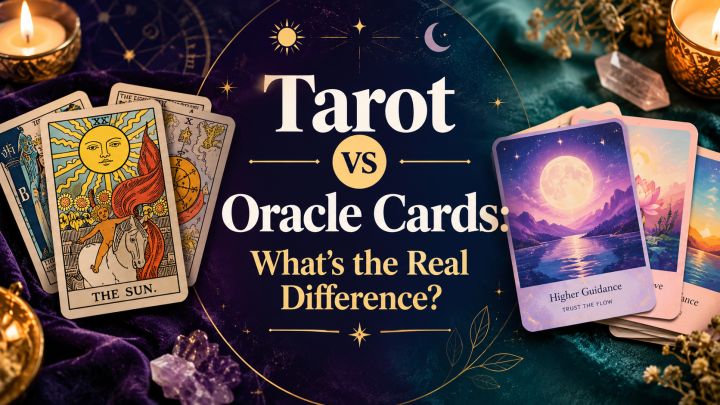
Tarot vs Oracle Cards: What’s the Difference and Which Should You Use?
astrology and tarot writer researching classical and modern divination sources · September 25, 2026
Quick Summary
- Tarot vs oracle cards comes down to structure: tarot follows a fixed 78-card system, and oracle decks don’t.
- Tarot started in 15th-century Italy as a card game, not a divination tool.
- Oracle decks have their own separate history. They didn’t evolve out of tarot.
- Neither is better. Each fits a different kind of reading, covered below.
If you’re standing in front of a shelf of decks trying to figure out tarot vs oracle cards, here’s the short version. Tarot follows a fixed 78-card structure with a shared meaning system. Oracle decks can be any size or theme, built around whatever rules the creator chose. The rest of this article covers what that difference actually feels like once you sit down to read.
[Image opportunity: a flat-lay photo of a tarot deck and an oracle deck side by side. Suggested alt text: “tarot deck and oracle deck compared side by side”]
What’s the Difference Between Tarot and Oracle Cards?
The difference between tarot and oracle cards starts with structure. Every tarot deck, regardless of artist or theme, uses the same 78-card framework: 22 Major Arcana cards plus 56 Minor Arcana split across four suits.
That structure goes back to 15th-century Italy, where tarot began as an add-on to existing playing cards for a trick-taking game called tarocchi, not for fortune-telling. The divination angle came centuries later, according to History.com’s account of tarot’s origins.
Oracle decks don’t share that structure, or that history. A deck might have 20 cards or 65, built around astrology, animals, affirmations, or any theme the creator has in mind, with its own rulebook instead of an inherited tradition.
The Lenormand deck, one of the earlier influential oracle systems, shows how separate that lineage really is. It grew out of a German parlor game called Das Spiel der Hoffnung (“The Game of Hope”) from around 1799. The deck only picked up the name of French fortune-teller Marie Anne Lenormand after her death, once cartomancy readers had already adopted it, as Spiral Nature’s history of the Lenormand oracle explains.
In other words, oracle decks aren’t a watered-down version of tarot. They’re their own tradition that happened to take shape around a similar era.
Tarot Card Comparison at a Glance
| Feature | Tarot | Oracle |
| Card count | Fixed at 78 | No standard |
| Structure | Major + Minor Arcana, four suits | No required structure |
| Learning curve | Steeper: meanings build on each other | Often easier to approach, with meanings specific to the deck |
| Consistency across decks | High for the core structure, though imagery and interpretation still vary by deck | Lower: meanings and structure vary by deck |
Here’s the part most tarot card comparison guides leave out: because tarot’s structure is standardized, the knowledge carries over. Learn the Rider-Waite-Smith system, first published in 1909 and still the most-used reference point for modern tarot according to the Victoria and Albert Museum’s collection notes, and you can pick up almost any other tarot deck already knowing how to read it.
Oracle decks work differently. “Renewal” might be one card in one deck and not appear at all in the next.
Which Is Better, Tarot or Oracle Cards?
Neither wins outright. They suit different things, and a few honest questions can help you figure out which fits you:
- Do you want quick, direct answers, or a fuller picture? Asking “what should I focus on today” is oracle territory: pull one card, get a direct message. Want to see how several things interact at once? Tarot’s structure handles multi-card spreads better.
- Are you up for learning a system, or do you want something usable right away? Tarot rewards study, since the Major and Minor Arcana build on each other over time. Oracle decks are readable straight out of the box, because most ship with a guidebook for that specific deck.
- Do you want your knowledge to carry over to future decks? Tarot’s shared structure means what you learn on one deck applies to the next. Oracle decks reward following your taste, though you’ll start fresh with each new one either way.
If “quick and intuitive” describes what you want, start with oracle. If “I want to actually learn a system” sounds more like you, tarot’s steeper learning curve pays off.
Try this today: pick whichever one sounds more like you and do a single one-card pull. You don’t need to commit to a whole system to find out if it fits.
Can You Use Both Together?
Yes, and plenty of readers do. A common approach uses tarot for the bulk of a reading, then pulls one oracle card at the end to summarize. Some readers flip that order: oracle first to set a tone, tarot to unpack it.
Because the “rules” only apply inside each deck’s own system, nothing stops you from mixing them.
What to Expect From an Oracle Card Reading
An oracle card reading plays out more simply than a tarot one. Most oracle decks are built for single-card or small-spread pulls: you ask a question, shuffle, draw, and read the meaning straight from the included guidebook.
There’s no suit structure to track and nothing to memorize about how cards interact with each other, which is why many guides point beginners toward oracle first.
Frequently Asked Questions
Is it okay to start with oracle cards instead of tarot?
Yes. There’s no required order. Most guides recommend oracle decks as the lower-friction starting point, and plenty of readers stick with oracle cards exclusively.
Do oracle decks have a wrong way to use them?
There’s no single system the way tarot has one. Each oracle deck sets its own guidance, usually in the included booklet, so “correct” use depends on the deck you’re holding.
Can tarot and oracle cards be read together in one session?
Yes. Many readers combine them, often using an oracle card to add a focused, single-message layer to a broader tarot spread.
Tags: difference between tarot and oracle, oracle card reading, oracle cards vs tarot, oracle deck guide, tarot card comparison, tarot vs oracle cards, which is better tarot or oracle
No Comments