Your Ultimate Guide to Numerology: How to Find Your Life Path Number and What It Means
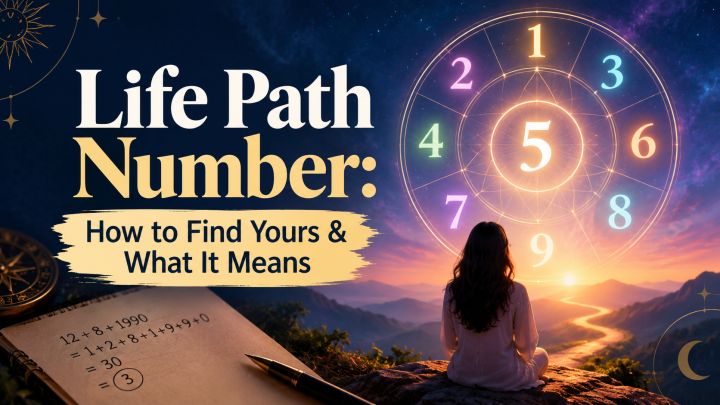
Quick Summary
- Comes from your full birth date and is one of numerology’s most widely used numbers.
- To find it: reduce your birth month, day, and year separately, then add the results together.
- Never reduce a master number (11, 22, or 33) if one shows up along the way. Doing so by mistake can flip your final result entirely, as shown below.
- Runs 1 through 9, with 11, 22, and (in many systems) 33 treated as master numbers.
Take September 29, 2000. Run it through the life path number formula one way and you land on a master number, 22. Run it almost the same way, with one extra reduction step most guides skip warning you about, and you land on an ordinary 4 instead.
Same birthday, two different numbers. This guide walks you through avoiding that mistake.
This number is drawn from your full birth date and describes the core theme of your life: the lessons you are here to learn, the traits you rely on, and the direction your choices tend to pull toward.
Whether you have read charts for years or want a numerology for beginners starting point, this is usually the first number people learn. Once you know how to calculate it, you can find it for anyone whose birth date you know.
What Is a Life Path Number?
A life path number is a single digit from 1 to 9, or occasionally a master number like 11, 22, or 33, calculated by reducing your full birth date through addition.
Numerologists frequently compare it to a sun sign in astrology: broad, foundational, and typically the first number a person learns about their own chart, except this one comes from arithmetic instead of planetary position.
The philosophy behind it is old. The Pythagorean tradition, founded in the 6th century BC, practiced a numeric-letter system called isopsephy, which many later numerology systems drew on.
The word “numerology” itself is newer than that philosophy: it was not recorded in English until around 1907, centuries after the Pythagorean ideas it is associated with.
Numerology today is generally treated as a belief system rather than a scientific method, and that is the right way to approach it here: as a tool for reflection, not a fixed prediction about your future.
How to Find Your Life Path Number
A widely used method for finding your life path number works like this. Grab your own birth date and follow along.
Step 1: Write out your birth date in month, day, year format. Take June 14, 1990, as an example.
Step 2: Reduce the month to a single digit. June is the 6th month, so it is already single-digit: 6.
Step 3: Reduce the day. 14 becomes 1 + 4 = 5.
Step 4: Reduce the year. 1990 becomes 1 + 9 + 9 + 0 = 19, then 1 + 9 = 10, then 1 + 0 = 1.
Step 5: Add the three reduced numbers and reduce again if needed. 6 + 5 + 1 = 12, then 1 + 2 = 3. This person’s life path number is 3.
Try your own birth date now, before you keep reading. Numerology sticks better once you have calculated your own number instead of reading about someone else’s.
The Master Number Mistake That Can Change Your Result
Most guides tell you not to reduce a master number, 11, 22, or 33, if one shows up while you are working out your month, day, or year. Fewer show you what happens if you do it wrong anyway. Here is a real example.
Take September 29, 2000. The month is 9. The day, 29, reduces to 2 + 9 = 11.
Because 11 is a master number, the correct method keeps it as 11 instead of reducing it further to 2. The year, 2000, reduces to 2 + 0 + 0 + 0 = 2, already single-digit.
Add the three correctly: 9 + 11 + 2 = 22. Since 22 is also a master number, it stays as 22. This person’s life path number is 22.
Now make the common mistake: keep reducing the day past 11, down to 1 + 1 = 2. The math becomes 9 + 2 + 2 = 13, which reduces to 1 + 3 = 4.
One extra reduction step turns a master number 22 into an ordinary 4, a different number with a different meaning.
That is the difference between reading a rule and watching it work. Whenever your month, day, or year lands on 11, 22, or 33 partway through, stop reducing that piece and carry the master number straight into your final addition.
Life Path Number Meaning: 1 Through 9
Here is what each number generally represents in numerology. Treat these as broad themes, not guarantees.
| Life Path Number | Core Theme |
| 1 | Independence, leadership, and a drive to start things rather than follow |
| 2 | Diplomacy, partnership, and sensitivity to other people’s needs |
| 3 | Creativity, expression, and communication |
| 4 | Structure, discipline, and steady, practical progress |
| 5 | Change, freedom, and curiosity about new experiences |
| 6 | Responsibility, caretaking, and a pull toward home and community |
| 7 | Introspection, analysis, and a search for deeper understanding |
| 8 | Ambition, authority, and a focus on material achievement |
| 9 | Compassion, idealism, and a wide view of the world beyond yourself |
Life path number 1 sits at the start of the whole sequence, which is why it is tied to initiative and going first. The specific shade of that trait still shifts depending on the rest of a person’s chart.
Master Numbers 11, 22, and 33
Many numerology systems treat 11 and 22 as master numbers, carrying a more intense, less settled version of their reduced counterparts, 2 and 4. Some systems also count 33, tied to 6.
None of the three get reduced at the end of a calculation, and they are generally described as carrying more potential, and more pressure, than an ordinary number.
What Is My Numerology Number? Life Path vs. Other Core Numbers
Your life path number is not the only number in numerology. It comes from your birth date and describes your overall direction in life. Your expression number, by contrast, comes from the letters in your full birth name and points to natural talents.
Your soul urge number, also drawn from your name, reflects what you want on the inside rather than what you show the world.
When someone asks what their numerology number is without naming a specific one, they almost always mean the life path, since it is the broadest and most commonly discussed.
Life Path Number Compatibility
People often want to know how their number lines up with someone else’s, especially in relationships. Some numerology systems treat this as a matter of complementary traits, not strict matches: a life path 1, for example, is sometimes considered compatible with 3 or 5, both numbers associated with independence.
Two people sharing the same number can either understand each other deeply or clash over shared weaknesses. Read these pairings as one system’s tendencies, not rules that predict how a relationship will go.
Once you have calculated your own number, try it for a partner, sibling, or close friend and see how differently the two show up in a relationship you already know well.
Frequently Asked Questions
Does everyone with the same life path number have the same personality?
No. It describes a broad theme, not a full personality. Two people can share a number and still be very different, since numerology also looks at expression, soul urge, and other numbers in a full chart.
Can my life path number change?
No. It is fixed by your birth date, so it stays the same for life, unlike numbers based on the current year or a name change.
Is a master number life path better than a regular one?
Not necessarily. Numerology systems describe master numbers as more intense, not more fortunate, and often note they come with more pressure to live up to their own potential.
Finding Your Own Number
Your life path number is a starting point, not a verdict. It is one lens, based on your birth date, for noticing patterns that show up again and again in your choices and relationships.
The calculation takes less than a minute once you know the steps. The real value is in watching a small mistake, like the one above, change the answer entirely.
This article treats numerology as a tradition for reflection and self-exploration, not a scientific or predictive method, and is not a substitute for professional advice on health, legal, or financial decisions.
Tags: how to find life path number, life path number, life path number 1, life path number compatibility., life path number meaning, numerology calculator, numerology for beginners, numerology guide, what is my numerology number
No Comments