How to Read Your Birth Chart: A Beginner’s Guide
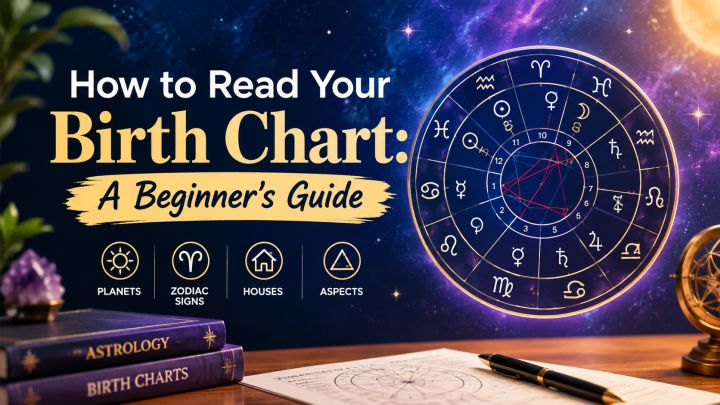
Quick Summary: A birth chart maps where the sun, moon, and planets sat in the sky the moment you were born. Start with your Sun, Moon, Rising, and Midheaven. Then look at the other planets, the houses they fall in, and the lines connecting them, which are called aspects.
Different chart calculators can place a planet in different houses. That depends on which house system they use. It’s normal, not a mistake.
You enter your birth date, time, and city, then hit generate. Now there’s a wheel on your screen covered in symbols that look like a cross between hieroglyphics and a math test. That wheel is your astrology birth chart, and it’s a lot to take in at first.
This guide covers the basics, not a full astrology course. You only need a handful of pieces to make sense of it. If you don’t have a chart yet, use a free birth chart calculator, enter your birth date, time, and location, and it will generate one for you.
A birth chart, also called a natal chart, maps where the sun, moon, and planets sat in the sky when you were born. It’s not a prediction of what happens to you. Think of it as a weather report for the sky on your birthday, a snapshot, not a forecast.
Here’s how to read your birth chart, piece by piece.
What Is a Birth Chart?
A birth chart is a circular diagram split into 12 slices, called houses. The zodiac wheel wraps around the outside, with symbols marking where each planet sat that day. To generate an accurate chart, you need your birth date, your birth time down to the minute, and your birth location.
Birth time matters more than most people expect. Without it, the calculation can’t place your rising sign or houses right, and those two things anchor the rest of the chart. If you don’t know your exact birth time, check your birth certificate.
An hour off can sometimes shift your rising sign into a different zodiac sign, changing a good part of the reading.
Start With Your Big Four: Sun, Moon, Rising, and Midheaven
Most beginners start here. It’s the fastest way into a chart that otherwise looks like noise.
Sun sign is the one most people already know. It’s the sign tied to your birthday, marked with a circle-and-dot symbol (☉). Astrologers connect it to your core identity and general direction in life.
Moon sign sits at the crescent symbol (☽). It’s linked to emotional patterns: how you process feelings, not how you present yourself.
Rising sign, or Ascendant, is the zodiac sign climbing over the eastern horizon at your exact birth moment. It sits on the left edge of the wheel and marks the start of your first house. It’s tied to first impressions and outward style.
Midheaven, or MC, sits at the top of the wheel. It represents your public life, including career direction, reputation, and the mark you leave outside your private world. It’s talked about less than the other three, but most full readings treat it as an important part of the chart.
Here’s an example. Someone with Sun in Virgo, Moon in Pisces, Rising in Leo, and Midheaven in Capricorn might seem warm and confident at first meeting, which is the Leo rising, while underneath they may be detail-oriented and practical, the Virgo sun, with a quieter side than people assume, the Pisces moon.
They likely have a drive toward long-term career goals, the Capricorn Midheaven. None of this is a fixed rule. It shows how natal chart interpretation works: combine the pieces and read them as a set.
The Other Planets in Your Birth Chart
Beyond the Sun and Moon, your chart includes eight more bodies: Mercury, Venus, Mars, Jupiter, Saturn, Uranus, Neptune, and Pluto. Each one relates to a different area of life.
Mercury relates to communication and thinking style. Venus relates to attraction, taste, and what you value. Mars relates to drive and how you take action.
The outer three planets, Uranus, Neptune, and Pluto, move slowly and can sit in the same sign for years. Astrologers often read them as generational markers rather than personal ones. For an individual reading, the house they fall in matters more than the sign.
Every planet placement has three parts: the planet, the sign, and the house. Venus in Scorpio in the 5th house, for example, points to someone who loves intensely and expresses that through creative pursuits or romance. Change one part and the meaning shifts.
One more concept helps once you know the basics: the chart ruler. This is the planet that rules your Rising sign. If your Rising sign is Scorpio, your chart ruler is Mars, or in modern astrology, Pluto.
Some astrologers treat the chart ruler’s sign and house as a theme that colors the rest of the chart. It’s not essential for a first read, but it’s a useful next step once the Big Four feel familiar.
Astrology Houses, Explained
The 12 houses divide your chart into life areas: relationships, career, home, money, and more. They’re based on your Rising sign and the earth’s rotation on your birth date. The first house starts at your Ascendant, and the rest follow counter-clockwise around the wheel.
The 1st house covers identity and appearance. The 4th covers home and family. The 7th covers partnerships. The 10th covers career and public life, where your Midheaven also sits. The rest fill in daily life: money (2nd), friendships (11th), and the subconscious (12th).
Here’s something most beginner guides skip: not every chart calculator divides the houses the same way. Whole Sign is one of the oldest systems. It comes from Hellenistic astrology about 2,000 years ago and gives one full zodiac sign to each house.
Placidus is different. It was developed by astrologer and mathematician Placidus de Titis and became popular in the 1600s. It divides the sky by time and your exact birth latitude, which produces houses of uneven size. Read more on Placidus’s background and the history of the system.
That’s why two free birth chart tools can place the same planet in different houses, even with identical birth details. They’re using different math on the same sky. If a reading looks off, check which house system the tool used before assuming your birth time is wrong.
What Are Aspects?
Aspects are lines drawn across the middle of the wheel. They connect one planet to another, and each line shows the angle between those two planets at the moment you were born.
A few common types: a conjunction happens when planets sit close together, blending their energies. A trine, about 120 degrees apart, reads as an easy, flowing relationship. A square, about 90 degrees apart, reads as friction that pushes growth.
You don’t need to memorize every angle right away. The lines represent relationships between planets, not decoration, and knowing that makes the whole chart feel less intimidating.
Spotting Patterns Once You Know the Basics
Once you know the Big Four, the planets, and the houses, the real skill is noticing repetition. If three or more planets cluster in one sign or house, astrologers call that a stellium, meaning that sign, or that house’s life area, carries extra weight across the chart.
A simple way to check: list every planet next to its sign and house, then scan for any sign or house that shows up more than twice.
A Simple 5-Step Way to Read Your Birth Chart
Use this process instead of rereading the whole guide each time:
- Confirm your birth date, time, and location in your chart calculator. Everything else depends on this.
- Find your Big Four: Sun, Moon, Rising, and Midheaven.
- Go planet by planet. Read each as planet, sign, and house.
- Check the major aspects connecting your Sun, Moon, and Rising to the rest of the chart.
- Scan for patterns: a stellium, or any sign or house that repeats.
That’s the whole method. Everything else adds depth, not a new process.
A Note on How to Use This
Astrology, including birth chart reading, is a symbolic and interpretive tradition. It’s not a scientifically verified system, and different schools, such as Western, Vedic, and Hellenistic, read the same chart differently.
Treat your chart as a tool for reflection, not fixed fact. Be cautious of any reading that claims certainty about your health, money, legal situation, or a specific future. No chart can responsibly promise that.
How to Read Your Birth Chart: Putting It Together
You don’t need to memorize a textbook to read your birth chart for the first time. Start with your Sun, Moon, Rising, and Midheaven, add in the planets and their houses, and let the aspects and patterns fill in as you go.
The chart isn’t going anywhere. You can return to it as you pick up one new symbol at a time.
Want to keep going? Spend a few minutes this week looking up your own Sun, Moon, Rising, and Midheaven, and write one sentence about how each shows up in your life.
If a placement in your chart confuses you, check it against a second source before deciding what it means. Astrology has more than one school of thought, and a second opinion clears up more than a first read does.
Tags: astrology birth chart, astrology houses explained, birth chart for beginners, birth chart reading, how to read your birth chart, natal chart interpretation, planets in birth chart, Sun Moon Rising signs, what is my birth chart
No Comments